
Bergkönig at Shelsley Walsh
Oil on Stretched Canvas 33” x 23”
I live locally to Shelsley Walsh Hill Climb, so I wanted to produce a painting depicting the famous hill. I considered various scenarios and which car to include, as Shelsley Walsh has a rich history, however I kept returning to 1936 when Hans Stuck drove his Auto Union up Shelsley Walsh. The Auto Union Type-C has long been one of my favourite historic cars, especially the hill climb variant with the double wheels on the rear axle.
My initial idea was clear, to show a scene looking down the hill with the famous Worcestershire countryside backdrop. The only issue with this idea being that the track was lined with more trees back in 1936 and the view wasn’t as open as it is these days. Having walked the hill I chose a spot just above the kennel crossing, which would allow the backdrop to be seen, with the historical treeline. The Type-C would be large on the canvas with the driver and car details clearly seen.
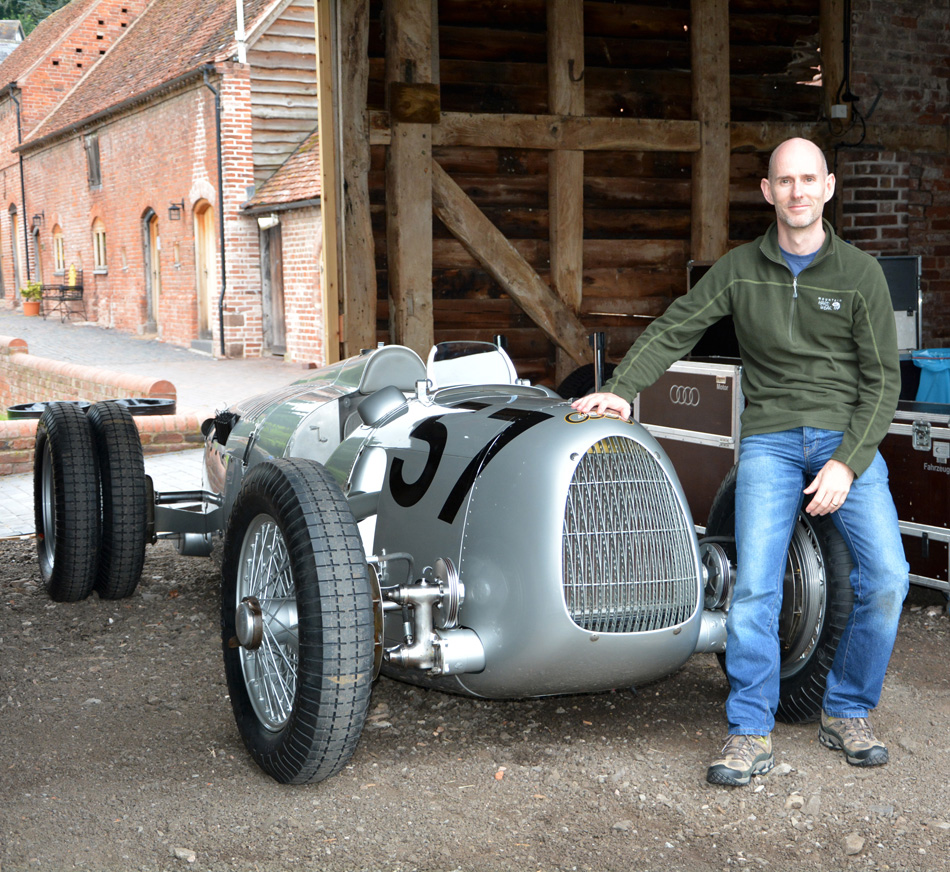
Having made the decision of which car to include, the first task was gathering accurate reference material. As luck would have it, a short while after settling on the idea I learnt that Audi were bringing their Type-C back to Shelsley for the Classic Nostalgia event and that Hans-Joachim Stuck (son of Hans Stuck) would be driving the car up the hill again. This was clearly my opportunity to gather the necessary reference material for my painting and not to be missed.
I prefer to paint on larger canvases, when possible, to include intricate detailing to the particular car or aircraft that I’m painting. This is only achievable if the relevant detailed information is available, therefore I contacted the Midland Automobile Club (MAC) and arranged to view the Type-C prior to the planned event, to enable me to clearly study and photograph the car at the angle I wanted without the crowds.
I arrived Friday morning with the car already unloaded and proceeded to take numerous photographs, including numerous close-up shots of the suspension, brakes etc. which I would require in detail for my painting.
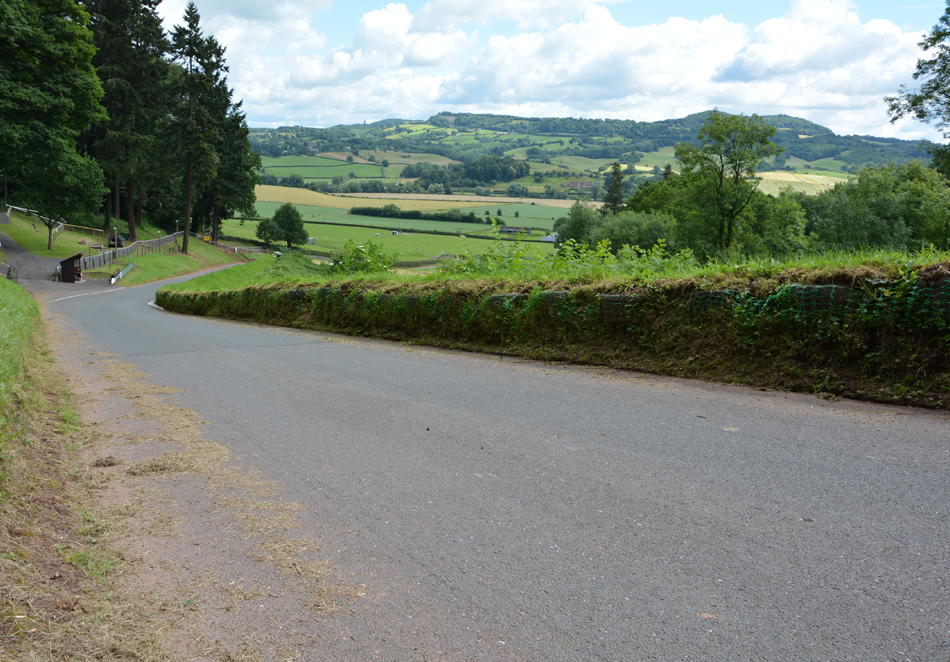
Previous to this I had been given access to walk the hill, to take numerous photographs of the track. It was now just a matter of combining my reference photos of the car with those taken on the hill to create the composition. Some artistic adjustments were made to reflect the track as it would have appeared in 1936, such as adding more trees, plus it was an overcast rainy day in 1936.
Shelsley Walsh is famous as being the oldest motorsport venue in the world, still run on its original layout.
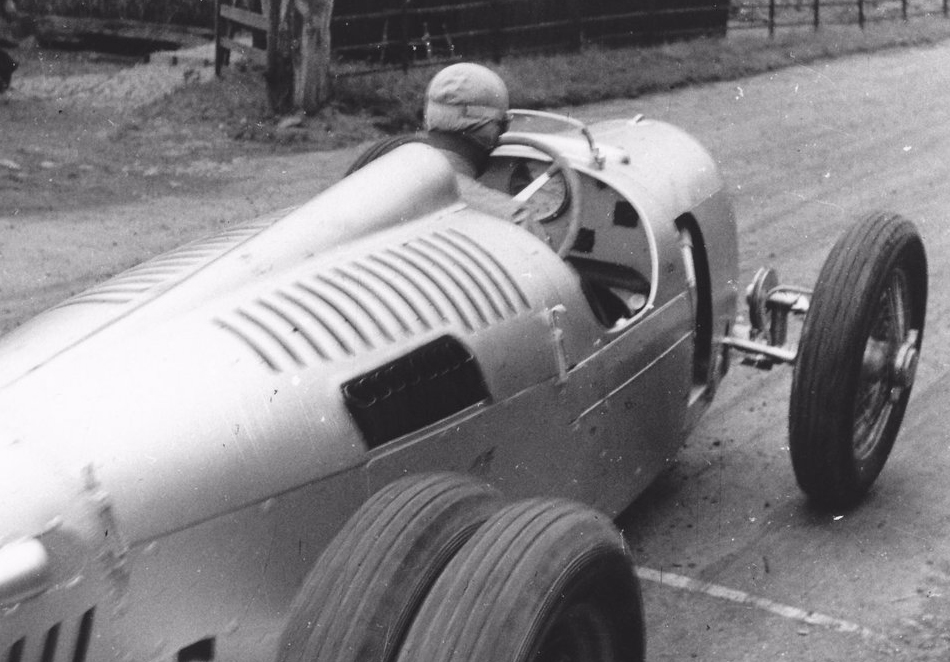
To ensure accuracy of the detailing, I also reviewed various historic photos of the Type-C taken at Shelsley in 1936 to determine any variations with the car. This included such things as the type of tyres and omitting the rear-view mirrors and top filler cap which weren’t present on the 1936 hill climb Type-C, compared to the Type-C I studied at Shelsley.
I gradually develop a painting with several thin layers of paint. Oil paints are translucent to a certain degree, so as each layer of paint is applied the image becomes more solid and defined. I prefer to paint this way, rather than applying a single thick layer of paint, as this process allows for a smooth finish, fine detailing and takes close scrutiny.
I firstly designed a composition and then drew the outline onto the canvas.
I then applied the first layer of paint, generally known as a blocking in layer. The canvas will be painted over several times, so this first coat doesn’t need to be overly detailed; it is just to provide basic form and colour.
I generally produce a painting using 3-4 layers of paint, plus a final detailing layer, with each layer getting more detailed.
This work in progress image shows the painting at approximately mid-stage.
It is now easier to visualise the final image, so the final layers can be applied without any major changes to the composition.
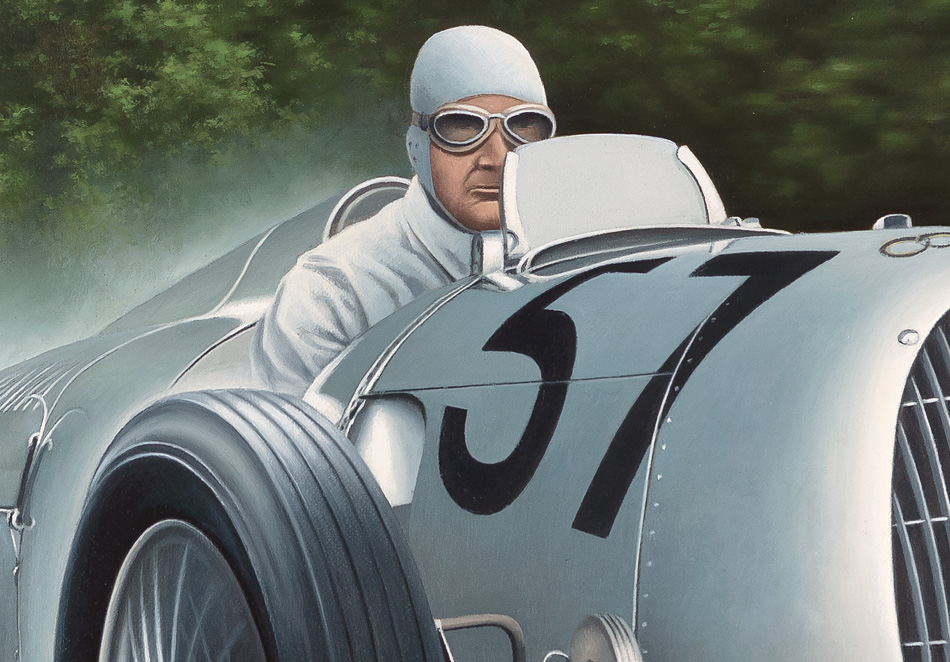
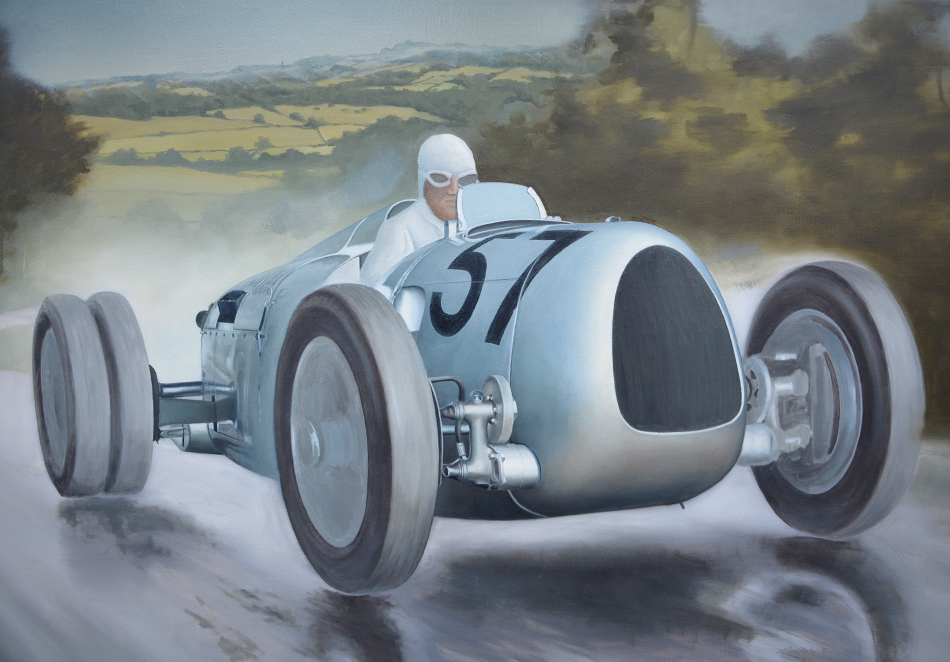
The car is quite large and detailed on the canvas, with the driver clearly visible and identifiable sat in the open cockpit. I therefore referenced old photographs of Hans Stuck to get a likeness, adding the type of goggles and leather cap he wore at that time.
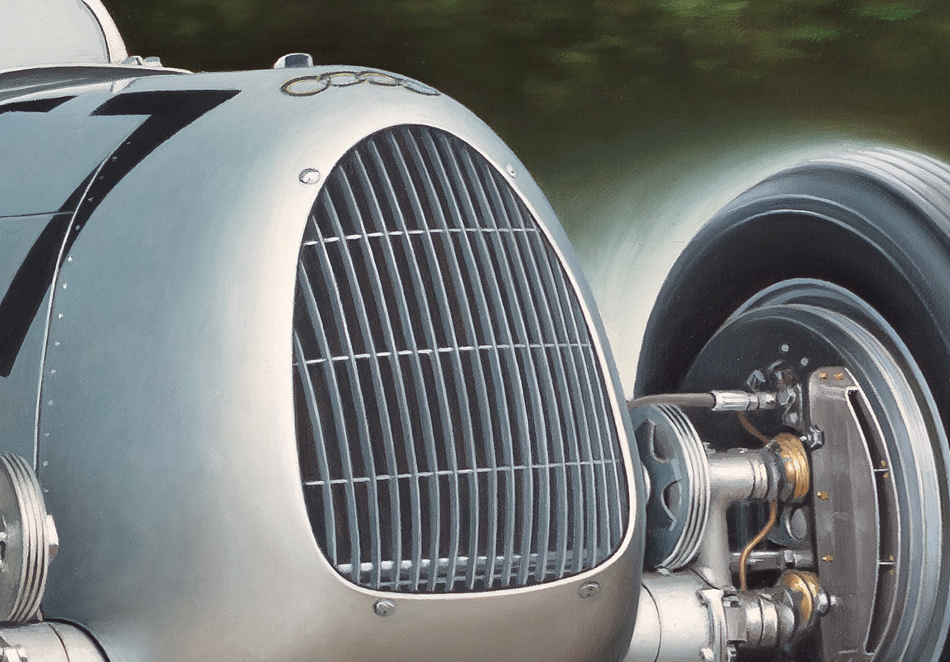
The final part of the painting process is to add all of the finishing touches, such as panel lines, weathering, exhaust staining, highlights and fine detailing.
The Type-C has very detailed front axles, so the close-up reference photographs I had taken previously at Shelsley Walsh were invaluable for portraying all of the smaller details accurately.
It is always important to get the details correct, and I enjoy adding the final detailing, it is my favourite part of the painting process. For me, a painting never looks complete until these little touches are added.

The end of the painting process. Sometimes a retouching varnish is required to reinvigorate some of the colours, usually the darker colours, but not always. The painting then needs to rest to allow the oils to harden, before applying the final varnish.
Prints from 'Bergkönig at Shelsley Walsh' are available. DETAILS

I wouldn't have been able to produce this painting, especially to include such detail, without the very kind assistance of the MAC and I am extremely grateful to them. As a thank you, I presented a full-size canvas print of the painting to the MAC.
I hope to work on more Shelsley Walsh themed paintings in the future.
If you compete at Shelsley Walsh and would like to commission a painting of your own car, then please contact me.