
Working The Problem
Oil on Stretched Canvas 30” x 23”
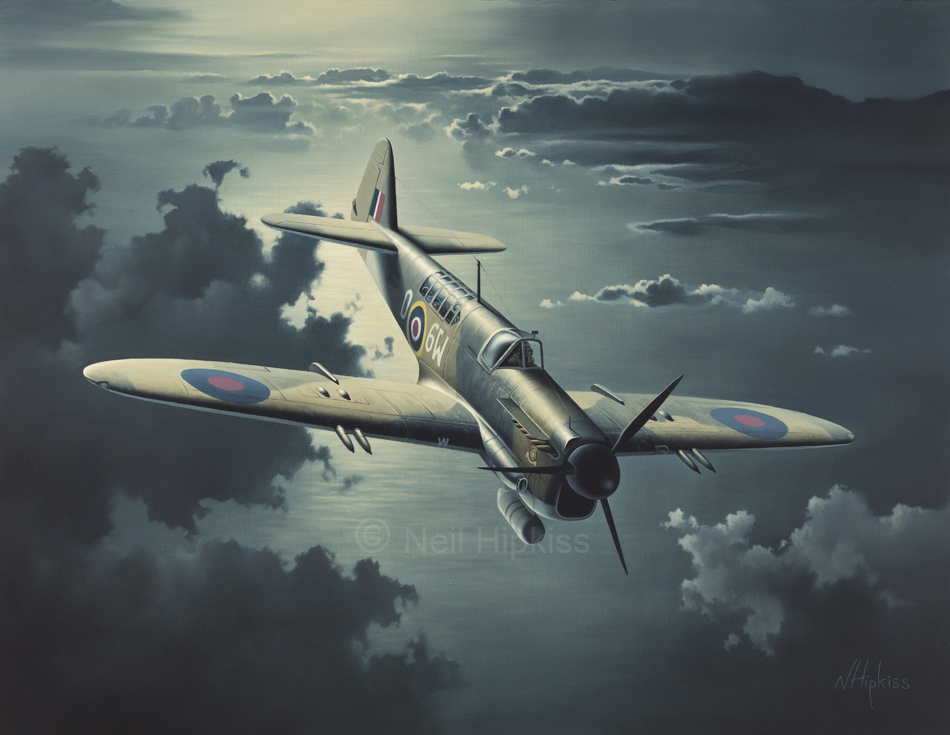
This was an interesting commission depicting an incident of airmanship, commissioned by the son of the pilot involved. I was provided with a detailed account of events and after an initial discussion it was agreed to portray the scene at the moment the drama unfolded, as the aircraft engine stopped whilst flying over open sea. The aircraft is shown in a slight nose down attitude and losing altitude as the pilot, Lt Harry Hunt, works through the various options that may have caused the problem.
On 19th September 1946 Lieutenants Harry Hunt (pilot) and John Keddie (observer) launched from HMS Ocean to conduct a routine night flying exercise in the eastern Mediterranean, in Firefly O-6W (PP 549) of Black Flight, 814 NAS. After half an hours flight, while at 6000 feet over open sea, the engine stopped. Losing altitude rapidly, Lt Keddie immediately radioed a ‘Mayday’ while Lt Hunt quickly worked through the various possible causes, surmising that there was probably a fuel contamination problem.
“...The altimeter was now moving far too fast for comfort – 2500ft and falling – and no matter how much I tried, the engine refused to run for long on the main tank. One action was left. There were approximately twenty gallons in each of the wing tanks. I cleared the engine again, switched to wing tanks and with “everything” crossed I managed to get the Griffon running again. We were down to 900 feet!
I set the controls for what amounted to a very long powered glide, zero boost and no more than 1800 rpm which I estimated would keep us airborne – engine permitting – for at least half an hour. The engine coughed a couple of times but continued to run – we were down to 500 feet when John picked up Ocean at about 5 miles and some 5 degrees to port. I altered course very carefully feeling that any harsh movement might disturb our present equilibrium and within a couple of minutes I spotted the ship glowing like Piccadilly Circus on Christmas Eve.
A slight cough from the Griffon reminded us that we still had to get aboard. We were now down below circuit height and I had no intention of carrying out normal procedures. Having identified the stern, I charged in. The DLCO was in his position, and without further ado, between us we completed a reasonable arrival. The Firefly was in one piece!“
The commanding Officer of HMS Ocean, Captain Caspar John, later to serve as First Sea Lord, wrote a ‘green ink’ commendation in the log book as follows: “When engine failed at night, pilot regained control of his engine, and rather than ditch alongside ships in the vicinity, returned to the carrier involving a flight of almost ½ hour in the dark with a doubtful engine. He landed in a low wind speed without damage and valuable information was obtained from the aircraft.”
The successful recovery of the aircraft allowed inspection and the determination that water contamination of the ships aviation fuel had occurred, which prevented the probable loss of aircraft due to launch the following day.